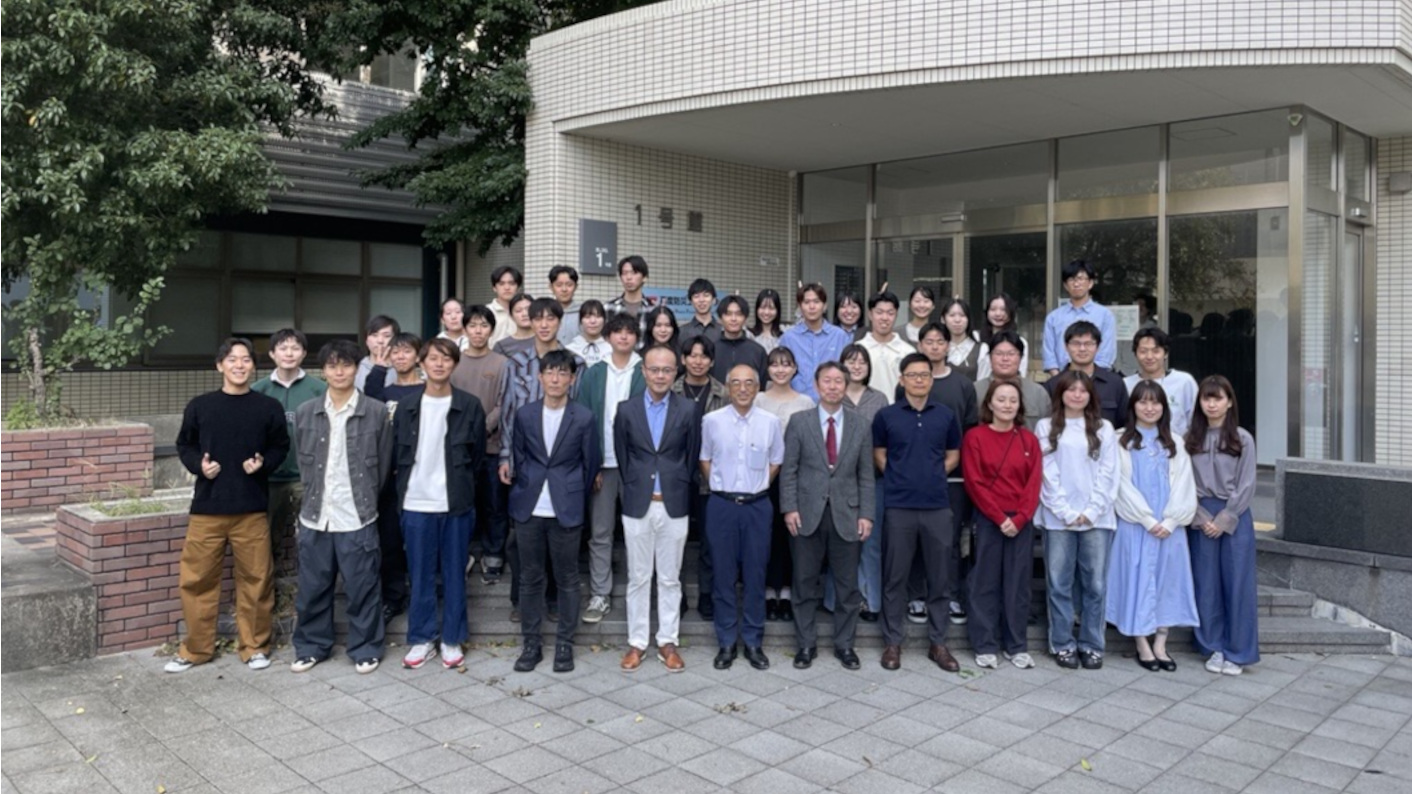
田中祐貴さん(加藤・古川G)の研究成果がJ. Chem. Eng. Japan誌にオープンアクセス論文として掲載されました。
論文タイトルは、"Mass Transfer Characteristic for Solid–Liquid Mixing with Floating Particles"です。
浮遊粒子を伴う固液撹拌における物質移動特性と、粒子を液面から液中へ引き込むための just complete drawdown 条件に関する研究成果が、 Journal of Chemical Engineering of Japan にRapid Communicationとして掲載されました。 本研究では、固液間体積物質移動係数 kLa と単位体積当たり撹拌所要動力 PV の関係を定量的に解析し、浮遊粒子の流動状態との対応から just complete drawdown の実用的な判定基準を示しました。
論文情報 / Publication
- Title
- Mass Transfer Characteristic for Solid–Liquid Mixing with Floating Particles
- Authors
- Haruki Furukawa, Yuki Tanaka, and Yoshihito Kato
- Journal
- Journal of Chemical Engineering of Japan, Vol. 59, No. 1, 2712141 (2026)
- Article type
- Rapid Communication
- Published
- 17 August 2026
- DOI
- 10.1080/00219592.2026.2712141
- Access
- Open Access (Creative Commons Attribution License, CC BY 4.0)
研究概要
浮遊粒子を含む固液撹拌では、粒子を液面から液中へ引き込むための最小撹拌回転数 (just complete drawdown speed, NJD)が、撹拌装置の設計やスケールアップにおける重要な指標です。 しかし従来研究では、NJD の判定に「液面で1–2秒以上静止する粒子がない状態」と 「液面に1–2秒以上粒子が存在しない状態」という異なる基準が用いられており、どちらが物質移動の観点から妥当かは十分に整理されていませんでした。
本研究では、直径0.185 mの邪魔板付き撹拌槽において、downward-pumpingおよびupward-pumpingの pitched-blade turbineを用い、イオン交換樹脂を浮遊粒子として実験を行いました。 イオン交換反応によるHCl濃度変化を電気伝導度から測定して固液間体積物質移動係数 kLa を求め、軸トルクから算出した単位体積当たり撹拌所要動力 PV との関係を調べました。さらに、kLa–PV関係に 区分回帰(segmented regression)を適用して変化点を統計的に検出し、独立に観察した浮遊粒子の流動状態と比較しました。
主な研究成果
- PV の増加に伴って kLa は急激に増加しますが、 ある PV を境に増加率が明瞭に低下することが示されました。
- kLa–PV関係について1変化点モデルと2変化点モデルを比較した結果、 Bayesian Information Criterion(BIC)に基づき、1変化点モデルの方が統計的に支持されました。
- 統計的に検出された変化点は、「液面に粒子が一時的に存在していても、1–2秒を超えて静止する粒子がなくなる状態」と良好に一致しました。
- 代表的なdownward-pumping pitched-blade turbine条件(C/H = 0.5)では、 この変化が PV ≈ 8.5 W/m3 付近で観察されました。
- 6つの翼設置・吐出方向条件に対する1変化点モデルの変化点は2.3–28.8 W/m3の範囲にあり、 翼を液面近く(C/H = 0.7)に設置した条件では、吐出方向によらず比較的低い PV で変化点が現れました。
- 以上から、浮遊粒子の NJD は、 「液面に粒子が存在することはあっても、1–2秒を超えて静止する粒子がない状態」として定義することが適切であると提案しました。
本研究の意義
本研究は、これまで主として目視観察によって議論されてきた浮遊粒子の just complete drawdown 条件を、 固液間物質移動特性と粒子流動状態の両面から定量的に検討したものです。 特に、撹拌回転数そのものではなく単位体積当たり撹拌所要動力 PV を用いて整理することで、 撹拌槽の設計・スケールアップに利用しやすい実用的な指標を与えます。 この知見は、スラリー調製、晶析・沈殿、吸着、溶解など、固液間の物質移動が重要となる撹拌操作の合理的な設計に役立つことが期待されます。
Research overview
In solid–liquid mixing with floating particles, the minimum impeller rotational speed for just complete drawdown, NJD, is an important parameter for the design and scale-up of stirred vessels. Previous studies, however, have used different observational criteria for determining NJD, and the particle-flow condition corresponding to efficient solid–liquid mass transfer has not been clearly established.
In this study, the volumetric solid–liquid mass transfer coefficient, kLa, was measured by an electrical-conductivity method based on ion exchange over a wide range of volumetric power consumption, PV. The kLa–PV relationship was analyzed using segmented regression, and the resulting change point was compared with independent observations of floating-particle behavior.
Key findings
- kLa increased rapidly with increasing PV, followed by a distinct decrease in its rate of increase above a characteristic PV.
- A one-change-point segmented regression model was statistically preferred to a two-change-point model based on the Bayesian Information Criterion (BIC).
- The identified change point corresponded to the transition from a condition in which some particles remained stationary at the liquid surface for more than 1–2 s to a condition in which particles could still transiently appear at the surface but none remained stationary for more than 1–2 s.
- For a representative downward-pumping pitched-blade turbine configuration at C/H = 0.5, this transition occurred at approximately PV = 8.5 W/m3.
- The results suggest that just complete drawdown of floating particles should be defined as the condition in which particles may still be present at the liquid surface but none remain stationary there for more than 1–2 s.
Significance
This study provides a mass-transfer-based criterion for determining the just complete drawdown condition of floating particles in stirred vessels. Organizing the transition in terms of volumetric power consumption, PV, rather than impeller rotational speed alone provides a practical basis for the design and scale-up of solid–liquid mixing operations involving floating particles.
Keywords / キーワード
Mass transfer; Solid–liquid mixing; Floating particles; Particle drawdown; Just complete drawdown; NJD; Stirred vessel; Agitated vessel; Volumetric power consumption; PV; kLa; Segmented regression; Pitched-blade turbine
物質移動;固液撹拌;固液混合;浮遊粒子;浮上性粒子;粒子引き込み;完全引き込み;撹拌槽; 撹拌所要動力;単位体積当たり撹拌所要動力;体積物質移動係数;区分回帰;区分線形回帰
Citation
Furukawa, H., Tanaka, Y., and Kato, Y. (2026). “Mass Transfer Characteristic for Solid–Liquid Mixing with Floating Particles,” Journal of Chemical Engineering of Japan, 59(1), 2712141. DOI: 10.1080/00219592.2026.2712141.
Additional information
本論文はOpen Accessで公開されています。研究はAmano Institute of Technologyの2025年度研究助成(2025–2026)の支援を受けて実施されました。
Publisher page: https://doi.org/10.1080/00219592.2026.2712141